
NEWS
Tokenisation Moved Into Bank Pipes After the FSB Warning
Twenty-three months after the FSB said tokenisation was too small to threaten stability, bank deposit tokens and a DTCC October service put the 2024 risk list.

In October 2024 the Financial Stability Board said tokenisation did not pose a material risk to financial stability, mainly because it was still small. By September 2026 banks, funds and market utilities were running that activity in production, on rails the Board already knows how to watch.
The 2024 paper treated DLT-based tokenised money and financial assets as a young corner of the system, and carved out crypto-assets and CBDCs. The growth that followed did not build a fifth pillar beside banks. It gave bank deposits a night shift, put Treasury funds on public chains, and queued a DTCC service for stocks and Treasuries in October 2026.
What the FSB Said Tokenisation Could Break
The Board’s report of 22 October 2024, issued to the G20, was narrow on purpose. It looked at DLT as the platform, and at tokenised financial assets and money that might serve as settlement assets. It did not review CBDCs. It did not review crypto-assets.
Public data, it said, was thin. Adoption looked “very low but appears to be growing.” On that basis the Board wrote that tokenisation does not currently pose a material risk to financial stability.
Tokenisation could have implications for financial stability if the tokenised part of the financial system scales up significantly, if increased complexity and opacity of tokenisation projects lead to unpredictable outcomes in times of stress, and if identified vulnerabilities are not adequately addressed through oversight, regulation, supervision, and enforcement.
Financial Stability Board, The Financial Stability Implications of Tokenisation, 22 October 2024
The weak spots it listed were familiar from ordinary finance: liquidity and maturity mismatch, leverage, asset price and quality, interconnectedness, and operational fragilities. A companion letter from the FSB Chair to G20 ministers asked authorities to close data gaps, to fit tokenisation into legal and supervisory frameworks, and to share more information across borders.
The paper also noted why the then-current crop of projects looked containable. Many sat on permissioned platforms, programmability was limited, and links to the rest of the system were still light. Those were conditions, not a permanent pass.
On-Chain Treasuries Are Still a Thin Slice
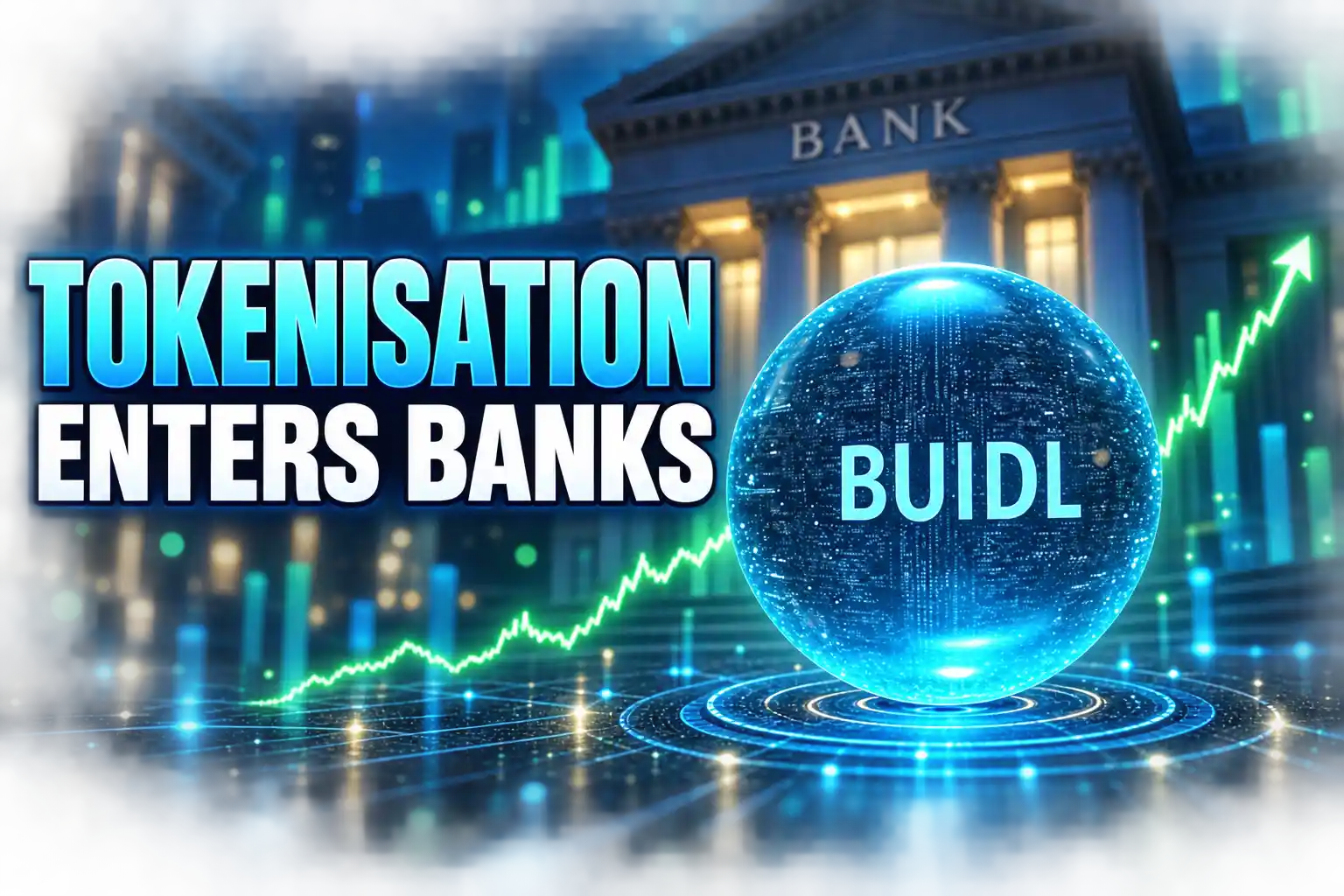
The on-chain book is larger than it was when the FSB wrote, and it is still small next to the markets it copies. Trackers compiled by Stobox put tokenized real-world assets, excluding stablecoins, at about $6.4 billion at the end of 2024. The rwa.xyz dashboard on 25 September 2026 showed distributed on-chain RWA value of $40.90 billion, about six times that end-2024 print.
Tokenized U.S. Treasuries and related money-market funds are the thickest slice of that book. The same dashboard, on 23 September 2026, counted $14.93 billion across 108 products, with a seven-day average yield of 3.50%. That is a real market. It is not a systemic one on size alone.
Leadership inside it keeps changing. BlackRock’s BUIDL fund, run with Securitize, has traded the top slot with Circle’s USYC. Ondo’s USDY sits in the same pack. On 25 September 2026 the dashboard had Circle first, then Ondo, then BlackRock.
LARGEST TOKENIZED TREASURY FUNDS
| Fund | Issuer | Size on 25 Sep 2026 |
|---|---|---|
| USYC | Circle | $2.4B |
| USDY | Ondo | $2.3B |
| BUIDL | BlackRock, via Securitize | $2.2B |
Ethereum hosted $16.8 billion of the $40.90 billion distributed total that day, with BNB Chain and Solana next. Most of these funds still screen wallets. Minimum tickets run into the millions on BUIDL. The tokens are fund shares with a chain record, not a new Treasury market.
Citi Institute’s Tokenization 2030 note, published in June 2026, put a base case of $5.5 trillion of tokenized assets by the end of the decade, and only if settlement money, market utilities and bank access all line up. The gap between $40.90 billion now and that base case is the part the 2024 paper was trying to watch.
Bank Deposits Got a Night Shift
The volume that matters for stability is not the public RWA dashboard. It is commercial-bank money that never leaves the bank, recorded as a token so it can move when CHAPS, Fedwire and correspondent desks are closed.
On 9 July 2026, Swift said its blockchain-based shared ledger was ready for initial use. 17 banks from six continents would pilot live payments in tokenised deposits. The group includes Citi, HSBC, UBS, BNP Paribas, BNY, Wells Fargo, DBS, Standard Chartered, MUFG Bank, Lloyds Bank, ANZ, OCBC, UOB, Mashreq, First Abu Dhabi Bank, FirstRand and Itaú Unibanco.
Swift’s own description is easy to misread. The ledger is an orchestration layer. Each bank still issues the token on its own books. The shared record lets those banks commit to a payment overnight and on weekends. Final settlement still runs through existing systems, RTGS or correspondent accounts. Funds can move when the bank is open on-chain and still wait for the central-bank window that actually ends the payment.
Citi, in a September 2026 paper on digital-finance connections, said it was among the banks on that ledger from 9 July 2026, and that Citi Token Services already feeds 24/7 dollar clearing for more than 300 financial institutions across 50-plus markets. Ryan Rugg, Citi Services’ global head of blockchain strategy and DLT implementation, put the adoption test in one line: if firms have to stand up separate wallets, keys, nodes and books for digital assets, “it will be too complex for immediate widespread adoption.”
JPMorgan’s Kinexys platform has been in production for wholesale tokenised payments for years, which is the single-bank version of the same idea. HSBC has a tokenized deposit service live in several centres. The hard part, as Citi’s paper framed it, is a client of one bank paying a client of another without rebuilding correspondent chains in a new wrapper.
On 24 September 2026, IBM said a beta ISO 20022 adapter on Digital Asset Haven can reach Swift’s ledger, so banks can instruct tokenised-deposit payments in the message format they already send. That is plumbing, not a new coin. It also spreads operational risk onto vendors that sit beside the messaging network.
In the UK, Quant Network said UK Finance’s Great British Tokenised Deposit group, with Barclays, HSBC, Lloyds, NatWest, Santander, Monzo and Nationwide, had completed live customer payments, including two remortgage completions where funds locked and released at completion. That is programmability of the kind the FSB said was still limited in 2024, used on sterling bank money rather than on a crypto venue.
DTCC Plans an October Service for Stocks and Treasuries
If Swift is the overnight pipe for bank money, DTCC is the attempt to give the same treatment to securities that already live at The Depository Trust Company. In December 2025, DTC received an SEC no-action letter for a defined tokenization service, for three years, covering Russell 1000 stocks, major-index ETFs, and U.S. Treasury bills, notes and bonds.
DTCC said it ran real production trades in July 2026 after converting DTC-held assets into tokens. More than 30 firms took part on 15 July 2026, across collateral pledges, securities lending, Treasury and repo delivery-versus-payment, equity DVP and DVD, token transfers and CCP margin. The tokens ran on DTCC’s private Hyperledger Besu network and on Canton. The commercial service is scheduled for October 2026, as a voluntary option for eligible DTC participants. Tokens are digital twins of assets that stay in the depository and can convert back.
Citi’s September paper also described a June 2026 European Investment Bank DLT-native commercial paper issue of €77.5 million on Clearstream’s D7 platform, later used as Eurosystem-eligible collateral with the Deutsche Bundesbank. That chain, from issue to central-bank collateral, is the interconnection the 2024 report said was still light.
FROM THE FSB PAPER TO AN OCTOBER LAUNCH
- October 22, 2024: The FSB publishes its tokenisation report and tells the G20 the activity is too small to be a material stability risk.
- December 2025: The SEC issues a three-year no-action letter for DTC’s tokenization service on Russell 1000 stocks, major ETFs and U.S. Treasuries.
- May 18, 2026: The FCA and Bank of England set out a joint vision for tokenisation in UK wholesale markets and ask for industry views.
- July 9, 2026: Swift’s blockchain ledger goes live for initial use with 17 banks piloting tokenised-deposit payments.
- July 15, 2026: DTCC runs production trades in tokenized stocks, ETFs and Treasuries with more than 30 firms.
- October 2026: DTCC is scheduled to launch the Tokenization Service as a voluntary offering for eligible participants.
A BIS-led test, Project Agorá, separately moved about $1 million of real cross-border value in mid-2026 across six currencies, with 28 banks, in average times of about 80 seconds, using tokenised central-bank reserves and commercial-bank deposits. That was a pilot. Swift and DTCC are the production-shaped versions of the same bet: keep legal claims where they are, add a ledger that does not sleep.
The Liquidity Mismatch Now Runs Overnight
None of this makes the 2024 “not material” line false on the public RWA book. $40.90 billion is not a threat to global funding markets. The second-order change is where the five weak spots now point.
THE 2024 VULNERABILITY LIST
- Liquidity mismatch: Tokenised fund shares and deposit tokens can move when the underlying cash, Treasury or RTGS window cannot, so redemption and settlement clocks can diverge after hours.
- Leverage: Once those tokens are accepted as collateral, the same short-duration asset can support more than one exposure across venues that do not share a pause button.
- Asset quality: A token is only as clean as the claim behind it; wrappers, SPVs and allowlists can hide that claim until a stress test.
- Interconnectedness: Swift, DTCC, Canton, Besu and bank-specific ledgers now sit between the same names the FSB already lists as systemically important.
- Operational fragilities: Smart-contract errors, key handling, vendor adapters and the lack of a night-time unwind path are no longer hypothetical once 17 banks share an orchestration layer.
The sharpest version of the first and last items is already in Swift’s design. Banks can move client funds on weekends. They still finish through systems that keep office hours. A break at 2 a.m. does not wait for the morning reconciling team the way a batch payment does. Citi’s paper said as much: in a market that runs continuously, connection points carry more weight because there is no pause.
That is also why a running commentary that treats “24/7 tokenised deposits” as 24/7 finality is wrong. Swift said the opposite. IBM’s adapter, on 24 September 2026, was built to send standard payment messages into that layer. The operational risk is in the join, not in the token artwork.
Collateral is the other live wire. DTCC’s July tests included pledges, lending, repo and CCP margin. The Bank of England has said it is working so that tokenised versions of already eligible assets can be used as collateral at CCPs and in its own operations, and it is supporting a digital gilt pilot. When a tokenized Treasury fund share and a DTC twin of a Treasury note both start to fund other trades, the 2024 interconnectedness paragraph stops being a thought experiment.
How London and Washington Filled the Gap
The FSB did not publish a follow-up tokenisation report. Its 3 February 2026 work programme listed digital innovation and artificial intelligence among 2026 priorities, alongside NBFI, cross-border payments and operational resilience. The 2025 annual report, presented by Chair Andrew Bailey in March 2026, put the digital-asset energy into the 2023 crypto-asset and stablecoin framework, plus private credit and NBFI leverage. The 2024 tokenisation paper was left as a snapshot.
National authorities wrote the practical sequel. On 18 May 2026 the FCA and the Bank of England set out a shared vision for tokenisation in UK wholesale markets, after firms asked for clearer rules on capital treatment, tokenised collateral and settlement instruments. Sarah Breeden, the Bank’s deputy governor for financial stability, said the job now was moving from pilots to production to support financial stability and sustainable growth.
The Bank and FCA have done a huge amount to enable the responsible adoption of tokenisation in retail and wholesale finance in the UK, working with the government and the industry. The task now is for public and private sectors together to build on these strong foundations, moving from pilots to production to support financial stability and sustainable growth.
Sarah Breeden, Deputy Governor for Financial Stability, Bank of England, 18 May 2026
The same package included a Bank consultation on extending RTGS and CHAPS hours toward near-24/7 settlement, in stages, including weekends, subject to industry readiness. That consultation is the honest answer to tokenised deposits that move at night. The PRA also sent Dear CEO letters on the capital treatment of tokenised asset exposures and on innovations in deposits, e-money and stablecoins. The FCA pointed to its policy statement on fund tokenisation and to 16 firms in the Digital Securities Sandbox. A live synchronisation service is targeted for 2028.
In the United States the path was a no-action letter and a utility build, not a new FSB standard. DTC’s three-year SEC relief, the July production trades, and the October 2026 launch date are how U.S. cash Treasuries and large-cap stocks get a tokenised twin without rewriting the custody law around them.
Fragmented Ledgers Recreate the Old Correspondent Problem
Citi’s September paper opened with a figure from a Ripple, CB Insights and UK Centre for Blockchain Technologies study: banks have put more than $100 billion into blockchain since 2020. The result, the paper said, is parallel networks and liquidity pools that do not yet move as easily as the value they represent. Thierry Chilosi, Swift’s chief business officer, called the shared ledger “architecture by design,” a way to extend regulated bank money into continuous hours without inventing a new settlement asset.
That design choice is why the 2024 warning aged in a sideways way. The FSB asked what happens if a tokenised sector scales as a complex, opaque, highly programmable add-on. The path that actually reached production is bank claims and depository twins, on permissioned or tightly gated rails, stitched together with ISO 20022. The Board’s safer conditions were the ones that sold. The risks did not vanish. They moved into the joints: hours, collateral, vendors, and the chance that two ledgers disagree when no one is in the office.
The public RWA book can still grow a long way from $40.90 billion without answering that question. The October DTCC service, and the slow extension of RTGS hours in the UK, will show whether tokenised twins stay a voluntary overlay or become a second set of pipes for the same assets, with a night shift the original pipes do not yet keep.
Disclaimer: This article is news reporting and analysis of public official papers, market dashboards and company statements. It is informational only and is not investment, legal, regulatory or trading advice. It does not recommend buying, selling or holding tokenized funds, deposit tokens, securities or any other instrument, and it does not tell a firm how to treat those instruments for capital, custody or settlement purposes. Readers should consult a qualified financial adviser, counsel or licensed compliance professional before acting on any product, rule or operational change described here. Figures, rankings, pilot lists and launch dates reflect the cited sources as of their stated dates and can change as dashboards refresh and as Swift, DTCC and national authorities update their plans.

COSIMO digital’s $25 Million Raise Meets a Pending Irish License

Tokenisation Moved Into Bank Pipes After the FSB Warning

Komi’s 15 Crypto Mining Centers Ran Into Power and Law

Jason Derulo’s JASON Token Never Recovered From the Dump

Uphold Cut USDT for MiCA and Split Europe’s Dollar Rails
Uphold Cut USDT for MiCA and Split Europe’s Dollar Rails
Tokenisation Moved Into Bank Pipes After the FSB Warning
COSIMO digital’s $25 Million Raise Meets a Pending Irish License
Jason Derulo’s JASON Token Never Recovered From the Dump
Komi’s 15 Crypto Mining Centers Ran Into Power and Law
-
 NEWS2 years ago
Uphold Cut USDT for MiCA and Split Europe’s Dollar Rails
-
 NEWS2 years ago
COSIMO digital’s $25 Million Raise Meets a Pending Irish License
-
 ALTCOIN2 years ago
Jason Derulo’s JASON Token Never Recovered From the Dump
-
 BITCOIN2 years ago
Komi’s 15 Crypto Mining Centers Ran Into Power and Law